By Jim Farber
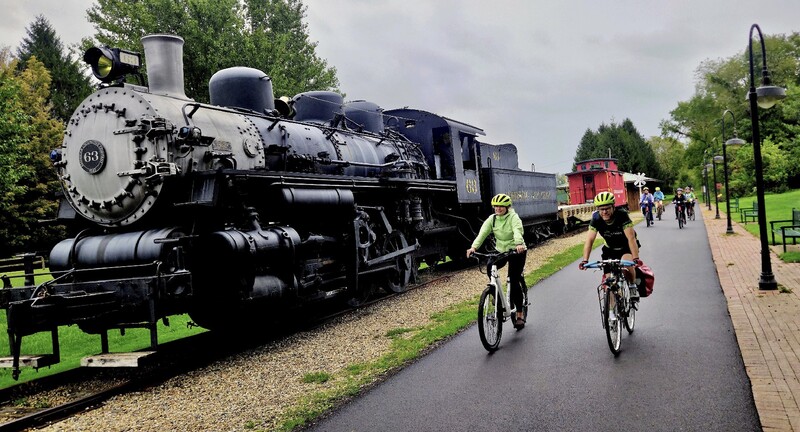
A 3% gradient may not sound like much. But in the age of rural railroads and steam locomotives, a 3% grade over the Kokosing Gap (connecting Danville and Gambier, Ohio) was as steep as it could go. So when I found myself huffing and puffing and pedaling up that 3.5-mile upgrade-turned-bike-path, beautiful as it was, I had to wonder what had I gotten myself into.
Then I realized I was part of a much bigger picture. Beneath my wheels I was literally riding over thousands of years of American history — game and trade trails used by countless generations of Native Americans; wagon tracks that guided pioneers of the westward movement and the ghost rails of America's railroads.
It was in February of 1986 that a diverse collection of conservation and parks groups, walking and biking enthusiasts, railroad history buffs and civic transportation advocates realized the potential if abandoned railroad corridors could be acquired and transformed into trails for public use. Over the course of the next 40 years the Rails-to-Trails Conservancy, working with local advocates, civic leaders and transportation planners, has coordinated the creation of more than 3,700 miles of public-access bike and hiking trails where everyone is welcome.
For five days in September, I traveled with a small group of companions from Pittsburgh, Pennsylvania, to Columbus, Ohio, with the Rails-to-Trails Conservancy. On sections of grated gravel and smooth blacktop we would ride for hours under a canopy of leaves dappled by a coming-and-going sun, follow streams and creeks, and cross trestles. We also made side trips to visit landmarks such as the Lincoln Bridge (on the Hellbender Trail), where the newly elected president nearly fell to his death before he could even take office.
In Orrville, Ohio, we watched a pride-filled Mayor Matt Plybon snip a red ribbon and declare the newest section of the Erie to Ohio Trail open. On the banks of the Ohio River, we heard the mayors of Steubenville, Ohio, and Weirton, West Virginia, advocate for a new multiuse bridge that would link the two states. Resident cyclists Melinda Vonstein and William Murdock, members of the Mid-Ohio Regional Planning Commission, joined us for the final leg to discuss challenges and victories achieved to make bike trails through Columbus ample and safe.
Along the way, Rails-to-Trails staff members Brandi Horton and Kevin Belle told us about the complexities of connecting existing gaps in the trails. They discussed issues of property acquisition and rights-of-way, federal and state funding sources, and the lack of available space for bike paths in congested cities such as Pittsburgh.
But the deepest impressions were left by cycling through ever-changing landscapes, like the sun after a rain igniting an Ohio cornfield and discovering gems of Americana seemingly frozen in time, like Mount Vernon, Ohio.
By the end, we had cycled sections of the Great Allegheny Passage, the Three Rivers Trail, the Montour Trail, the Panhandle Trail, the Heartland Trail, the Ohio to Erie Trail, the Holmes County Trail and the not-soon-to-be-forgotten Kokosing Gap Trail.
In many ways our experiences reminded me of my travels along the entire length of Route 66, which was christened "The Mainstreet of America" because it connected each town on the route, large and small. That vision is also a guiding principle of the Great American Rail-Trail's mandate to link visitors (domestic and international) with communities and in the process create opportunities for civic promotion, historic preservation, marketing and tourist-friendly development.
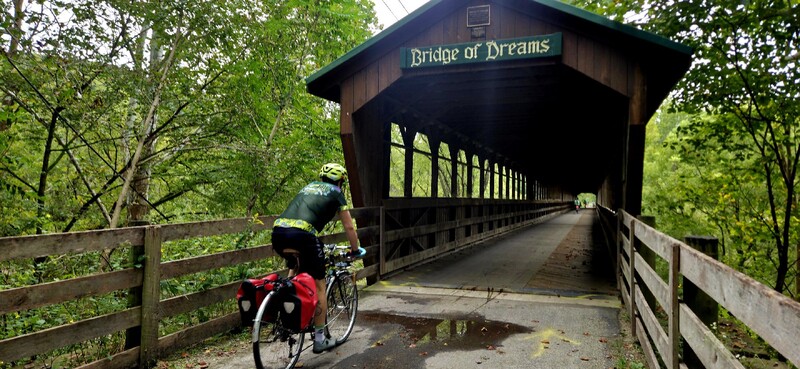
It all seemed to come together when we rode over the longest wood-covered bridge in Ohio — "The Bridge of Dreams." It seemed to personify the Rails-to Trails Conservancy's mission: "If you build it, they will come." A friend of mine likes to say that "life begins at the offramp." Cycling on the Great American Rail-Trail system, I came to realize that "life begins at the trailhead."
WHEN YOU GO
The Rails to Trails Conservancy: railstotrails.org
Jim Farber is a freelance writer. To read features by other Creators Syndicate writers and cartoonists, visit the Creators Syndicate website at www.creators.com.
Cyclists set off on the Great American Rail-Trail in Pennsylvania. Photo courtesy of Jim Farber.







View Comments